


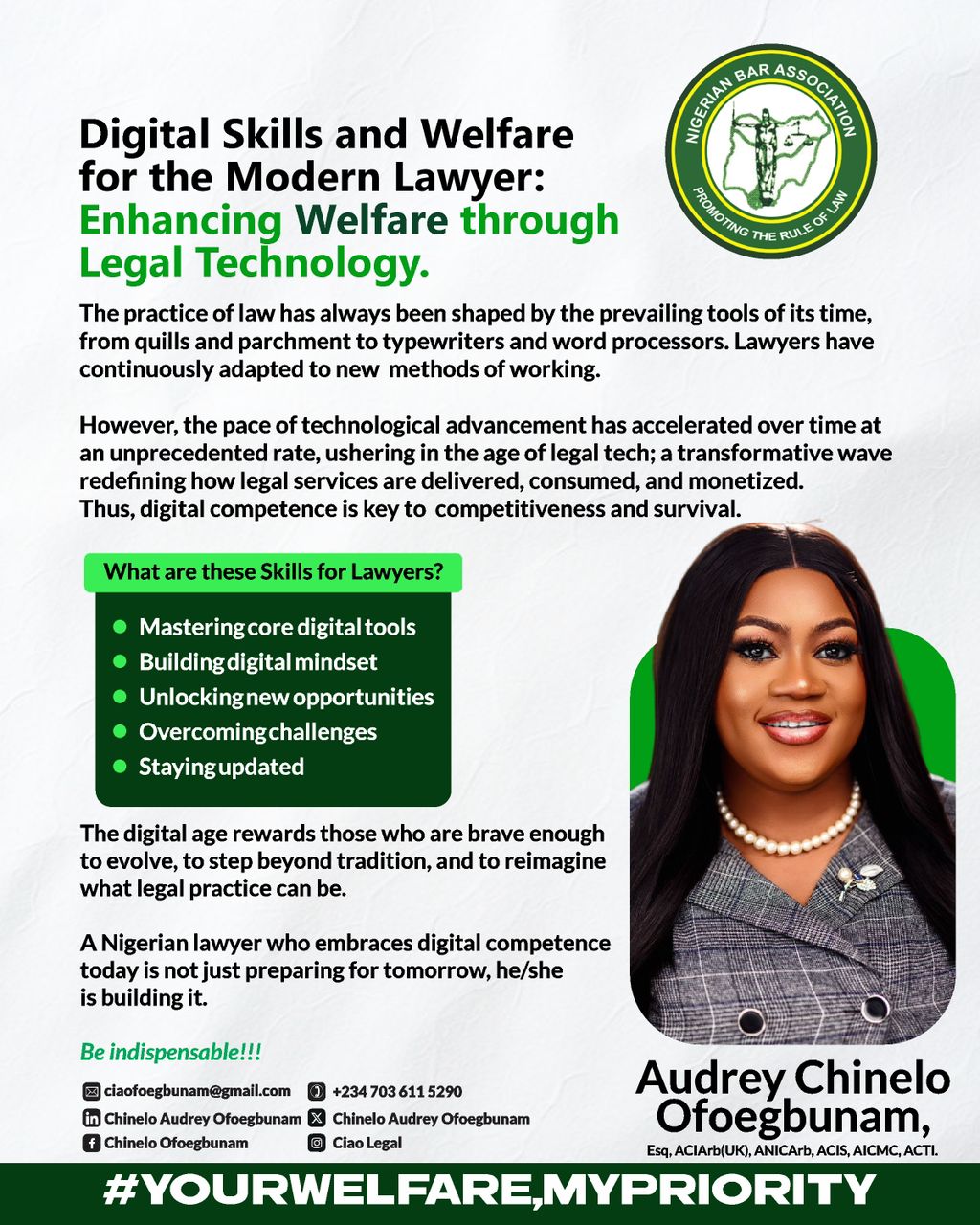
By; Audrey Chinelo Ofoegbunam
Introduction – The Digital Revolution in Law
The practice of law has always been shaped by the prevailing tools of its time, from quills and parchment to typewriters and word processors, lawyers have continuously adapted to new methods of working. Today, however, the pace of technological advancement has accelerated at an unprecedented rate, ushering in the age of legal technology (legal tech); a transformative wave redefining how legal services are delivered, consumed, and monetized.
For the modern Nigerian lawyer, digital competence is no longer optional; it is the bedrock of competitiveness, efficiency, and survival in an increasingly globalized legal market. Clients now demand faster turnaround times, cost-effective services, and innovative solutions, courts are gradually embracing e-filing, remote hearings, and electronic evidence management. Across the globe, lawyers are leveraging technology not just to practice law but also to reinvent themselves as problem-solvers, strategists, and innovators.
This moment presents both a challenge and an opportunity. Those who embrace digital skills will find themselves at the forefront of a new era of legal practice—one that values speed, precision, and creativity. Those who resist risk being left behind in an industry that is quickly discarding outdated methods. For Nigerian lawyers, the question is not whether technology will reshape the profession, it already has. The real question is: Will you adapt and thrive, or cling to the past and struggle?
Chapter One: Why Digital Competence Matters for Lawyers
1. Client Expectations Have Changed
Clients today expect transparency, speed, and accessibility. The days of clients waiting weeks for updates are over, technology has created a culture of immediacy.
2. Globalization of Legal Services
Nigerian lawyers are no longer competing only with colleagues in Lagos or Abuja. Remote work and digital platforms mean that lawyers in Canada, India, or South-Africa can just as easily provide cross-border services.
3. Efficiency and Cost-Effectiveness
Law is increasingly about delivering more value at lower costs. Lawyers who can automate processes, manage cases digitally, and leverage AI tools will outperform those still trapped in paper-heavy systems.
4. Professional Longevity
Technology shields lawyers from obsolescence. Just as typewriters gave way to computers, the next decade will see lawyers who embrace AI and blockchain outpacing those who resist innovation.
Chapter Two: Core Digital Skills Every Lawyer Must Master
1. Legal Research in the Digital Age
Gone are the days when legal research meant hours in a law library flipping through volumes of law reports. Today:
•Platforms like Nigerian Weekly Law Report, LawPavilion, LexisNexis, and Westlaw provide instant access to case law and statutes.
•AI-powered search tools help identify relevant precedents faster.
•Digital annotation tools allow efficient note-taking and sharing with colleagues.
A lawyer without digital research competence risks being slower, less effective, and less persuasive in court.
2. E-Filing and Digital Courtroom Skills
As Nigerian courts gradually adopt digital processes, lawyers must be competent in:
•Electronic filing of documents.
•Virtual hearings via Zoom, Microsoft Teams, or Court-specific platforms.
•Presentation of digital evidence.
•Cybersecurity in handling client files.
3. Document Automation
Clients do not want to pay for repetitive drafting. Tools like HotDocs, Contract Express, and Automio allow lawyers to automate standard contracts, saving hours of work while maintaining quality. Nigerian firms that adopt this early will be able to scale their services without proportionally increasing costs.
4. Project Management and Collaboration Tools
Modern legal practice often involves teamwork across multiple locations. Tools like:
• Trello, Asana, and Slack help manage workflows.
• Google Workspace and Microsoft 365 streamline collaboration on documents.
• Case management software organizes litigation timelines, deadlines, and filings.
5. Data Analytics for Legal Practice
In the U.S.A and U.K., predictive analytics is now used to forecast litigation outcomes and assess risks. Nigerian lawyers can also use data tools to:
• Track case outcomes in specific courts.
• Analyze timelines for dispute resolution.
• Provide clients with data-driven legal strategy.
6. Cybersecurity and Data Privacy
Client confidentiality is the cornerstone of legal ethics, with sensitive data now stored digitally, lawyers must understand:
• Secure file storage and encrypted communications.
• Password management and multi-factor authentication.
• Nigeria Data Protection Act compliance.
7. Artificial Intelligence and Machine Learning
AI is no longer futuristic—it is here. Tools like ChatGPT, Harvey AI, and Casetext are already assisting lawyers with:
• Drafting legal documents.
• Summarizing complex case law.
• Automating client communication.
Lawyers who learn to use AI responsibly will increase their billable efficiency and remain competitive.
Chapter Three: Beyond Tools – Building a Digital Literacy Mindset
In today’s rapidly evolving legal landscape, technology alone is insufficient for success. A digital literacy mindset is crucial for modern lawyers to thrive. This chapter explores the essential components of this mindset.
Key Components:
1. Curiosity: Embracing Lifelong Learning
A willingness to learn new tools and technologies is vital. Lawyers should stay updated on the latest developments in legal tech, embracing new tools and methodologies to enhance their practice.
2. Adaptability: Thriving in a Changing Environment
Comfort with constant change is essential. Lawyers must be adaptable, adjusting to new technologies, procedures, and client expectations.
3. Critical Thinking: Evaluating Digital Information
The ability to critically evaluate digital information is critical. Lawyers must assess the credibility, reliability, and relevance of online sources, ensuring informed decision-making.
4. Entrepreneurship: Leveraging Technology for Growth
Using technology to create new revenue streams is a key aspect of a digital literacy mindset. Lawyers can leverage digital platforms, tools, and services to expand their practice, improve efficiency, and increase profitability.
Benefits of a Digital Literacy Mindset
• Enhanced client service
• Improved efficiency and productivity
• Increased competitiveness
• New business opportunities
• Better adaptability to changing market conditions
A digital literacy mindset is essential for modern lawyers to succeed. By embracing curiosity, adaptability, critical thinking, and entrepreneurship, lawyers can navigate the complexities of the digital age and achieve their goals.
Chapter Four: Opportunities Digital Skills Unlock for Nigerian Lawyers
Digital skills are transforming the Nigerian legal landscape, offering numerous opportunities for lawyers to expand their practice and increase their earning potential.
1. Remote Practice and International Clients
Platforms like UpCounsel, Clio, and LegalZoom allow Nigerian lawyers to service international clients in areas like
• IP Registration: Assisting clients with intellectual property registration and protection globally
• Contract Drafting: Drafting contracts for international clients, ensuring compliance with global laws and regulations
• Compliance: Providing advisory services on compliance with international laws and regulations
2. Niche Practice Development
Tech-savvy lawyers can specialize in emerging areas:
• FinTech Regulation: Advising clients on regulatory compliance and navigating the complex fintech landscape
• Blockchain and Cryptocurrency Law: Providing legal guidance on blockchain technology, cryptocurrency transactions, and related issues
• Data Protection Compliance: Helping clients navigate data protection laws and regulations in Nigeria and globally
Alternative Revenue Streams
Digital skills also enable Nigerian lawyers to explore alternative revenue streams, such as:
• Online Legal Courses: Creating and selling online courses on legal topics, providing an additional source of income
• Subscription-Based Advisory Platforms: Offering subscription-based advisory services, providing clients with ongoing legal guidance and support
• Publishing Digital Books and Toolkits: Creating and selling digital books, toolkits, and other resources on legal topics
Emerging Areas of Law
Some emerging areas of law in Nigeria include:
• Cybersecurity Law: Advising clients on cybersecurity issues, data breaches, and related matters
• Environmental Law: Providing guidance on environmental regulations, sustainability, and climate change
• Health Law: Advising clients on healthcare regulations, compliance, and related issues
• Alternative Dispute Resolution (ADR): Providing mediation, arbitration, and other ADR services to resolve disputes efficiently
• Intellectual Property Law: Advising clients on intellectual property protection, registration, and enforcement
• Power Sector Law such as;
– Renewable Energy: The Act requires electricity generation companies to produce power from renewable sources or purchase renewable energy. The Nigerian Upstream Petroleum Regulatory Commission also mandates applicants for oil licenses to demonstrate low carbon emissions and possess a renewable energy program.
– Decentralization of Power Sector: The Act decentralizes the power sector, allowing states to regulate electricity activities within their jurisdictions. This development aims to improve energy access, delivery, and supply.
– State Electricity Markets: States can now establish their own electricity markets, regulatory authorities, and laws, promoting investment and efficient power supply.
– Renewable Energy Generation, Purchase, and Distribution Obligations: The Electricity Act imposes obligations on generation companies and distribution companies to promote renewable energy utilization.
– Energy Efficiency and Low-Carbon Development: Nigeria’s commitment to achieving net-zero carbon emissions by 2060 drives the need for energy efficiency and low-carbon development in the power sector.
– Mini-Grid Regulation: The NERC allows states to regulate these activities under the Electricity Act. Thus, lawyers can leverage on these.
– Electricity Theft and Offenses: The Act criminalizes electricity theft, meter tampering, and willful damage to electricity infrastructure, with corresponding penalties.
And the ongoing Power Sector Reforms aim to attract investment, improve efficiency, and increase energy access in Nigeria’s power sector. This is huge business for legal practitioners.
When we embrace these digital skills and engage in these emerging areas of law, we can stay ahead of the curve, expand their practice, and increase our earning potential.
Barriers to Digital Competence in Nigeria
1. Inconsistent power supply.
2. High cost of legal tech subscriptions.
3. Limited awareness of available tools.
4. Resistance to change among senior practitioners.
Despite these barriers, individual lawyers can still take initiative to train themselves and integrate affordable tools.
Chapter five: Roadmap to Becoming a Digitally Competent Lawyer
In today’s digital age, Nigerian lawyers must develop digital competence to remain competitive and provide efficient services.
1. Start Small – Master basic tools
• MS Word Advanced Features: Learn advanced features like track changes, document templates, and mail merge.
• Google Docs: Understand collaborative document editing and sharing.
• Zoom, google meets, videoconferencing: Master virtual meeting tools for remote communication.
2. Take Online Courses;
• Coursera: Enroll in courses on legal technology, digital literacy, and innovation.
• LinkedIn Learning: Take courses on productivity, technology, and business skills.
• Free Webinars: Attend webinars by global law-tech platforms to stay updated on industry trends.
3. Network Digitally – Build a professional brand on social media like;
• LinkedIn: Build a professional brand, connect with peers, and participate in relevant groups.
• Twitter: Engage with legal professionals, share insights, and stay updated on industry news.
• Legal Forums: Participate in online forums to discuss legal issues, share knowledge, and network.
4. Experiment with Automation – Start with templates and progressively adopt automation tools. Thus;
• Templates: Start with document templates to streamline workflow.
• Automation Tools: Tools like document automation software and practice management systems.
5. Stay Updated;
• Global Legal Tech Trends: Follow industry leaders, blogs, and news outlets to stay informed.
• Webinars: Attend webinars to learn about new technologies and best practices.
• Professional Tech Groups: Join groups to network with peers and stay updated on industry developments.
Benefits of Digital Competence
• Increased Efficiency: Digital competence streamlines workflow, reducing time and costs.
• Improved Client Service: Lawyers can provide more efficient and effective services to clients.
• Competitive Advantage: Digitally competent lawyers can differentiate themselves from competitors
Chapter Six: The Future of Legal Practice in Nigeria
The Nigerian legal market is slowly but steadily embracing digital transformation. The future will likely include:
1. Virtual law firms: With the rise of remote work and digital communication, virtual law firms are becoming increasingly popular. This model allows lawyers to work from anywhere, reducing costs and increasing flexibility.
2. AI-powered litigation prediction tools: Artificial intelligence (AI) is being used to analyze data and predict litigation outcomes. This technology can help lawyers make more informed decisions and provide better advice to clients.
3. Smart contracts powered by blockchain: Blockchain technology is being used to create smart contracts, which are self-executing contracts with the terms of the agreement written directly into lines of code. This technology can increase transparency, security, and efficiency in contract management.
4. Widespread digital evidence handling: As more evidence is presented in digital form, lawyers need to be equipped to handle digital evidence effectively. This includes understanding digital forensics, data storage, and security protocols.
Lawyers who resist digital skills will find themselves sidelined. Those who embrace it will lead the profession into a new era of accessible, efficient, and globally competitive practice.
Benefits of Digital Transformation in the Nigerian Legal Market
Increased Accessibility: Digital technologies can make legal services more accessible to a wider range of clients, including those in remote or underserved areas.
Improved Efficiency: Digital tools can streamline processes, reduce paperwork, and increase productivity, allowing lawyers to focus on high-value tasks.
Global Competitiveness: By embracing digital technologies, Nigerian lawyers can compete more effectively in the global market, providing services to clients across borders.
Challenges and Opportunities
While there are many benefits to digital transformation, there are also challenges to be addressed. These include:
• Resistance to Change: Some lawyers may be hesitant to adopt new technologies, which can make it difficult to implement digital transformation.
• Cybersecurity Risks: Digital technologies can increase the risk of cyber attacks and data breaches, which can compromise client confidentiality and trust.
• Digital Literacy: Lawyers need to have the necessary digital skills to effectively use digital technologies and tools.
Conclusion – The Digitally Empowered Lawyer
Competence in legal technology is no longer about prestige; it is about survival. The modern lawyer must see digital skills as part of professional ethics, ensuring efficiency, client satisfaction, and relevance in a rapidly evolving legal landscape.
For Nigerian lawyers, the path forward is clear: embrace digital transformation, invest in continuous learning, and build competence in legal technology. The lawyer who masters both law and technology will not only thrive but also reshape justice delivery in Nigeria for the better.
The digital age rewards those who are bold enough to evolve, to step beyond tradition, and to reimagine what legal practice can be. By harnessing tools like artificial intelligence, data analytics, e-discovery platforms, and virtual law offices, Nigerian lawyers can expand their reach beyond borders, serve clients with unmatched precision, and compete on a truly global stage.
This transformation is not just about tools; it is about mindset. It is about cultivating adaptability, curiosity, and the courage to learn anew. As the legal profession continues to intertwine with technology, the digitally empowered lawyer will emerge not only as a guardian of justice but also as an architect of innovation.
In the end, the future belongs to the lawyer who does not fear change but sees it as the very canvas upon which to paint a more efficient, equitable, and dynamic legal system. The Nigerian lawyer who embraces digital competence today is not just preparing for tomorrow, they are building it.
Call to Action: Every lawyer should set a digital goal for themselves this legal year; whether it is learning to use legal research software, building a professional presence online, or exploring AI-driven legal tools. Each step, no matter how small, brings you closer to being the kind of lawyer the future demands which are informed, innovative, and indispensable.
Connect with me on Social Media:
X: Chinelo Audrey Ofoegbunam
LinkedIn: Chinelo Audrey Ofoegbunam
Instagram: CIAO Legal
Facebook: Chinelo Ofoegbunam