

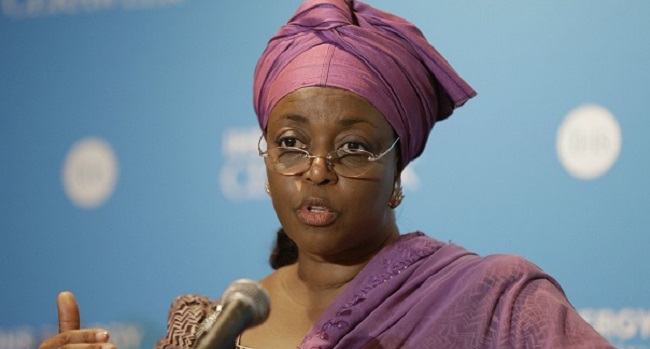
Former Nigerian petroleum minister Diezani Alison-Madueke has told a London court she became a target of powerful interests, was threatened and scapegoated, and did not take bribes as she tried to “clean up” Nigeria’s oil sector.
Taking the stand at Southwark crown court, Alison-Madueke said she “did not abuse” her office, “did not ask, seek or solicit bribes” and had always tried to act in good faith while balancing regional interests in government. She said that after she entered politics from outside Nigeria’s traditional political class and began pushing changes in a notoriously corrupt industry, “I became a target.”
She described Nigeria as “a very patriarchal and sadly misogynistic society” and said that combination made her position as a female oil minister a security risk. She told the jury she had been under threat of kidnap and that members of her family had in fact been kidnapped. By the 2015 election, she said, she had been told “to my face” that she would be made the scapegoat for wider political and economic anger.
Alison-Madueke is charged on six of eight counts under the Bribery Act. Prosecutors allege she received years of luxury advantages – the use of high-end accommodation, chauffeur-driven cars, private jet flights and designer shopping – from businessmen seeking to influence or reward her as oil minister, and that a payment to her brother was intended to induce contract awards.
In her evidence, the former minister tried to knit threats, kidnappings and missing records into a single story of pressure, but observers say her background also helps explain how she could quickly fall foul of Nigeria’s unwritten political rules.
Before she was appointed to cabinet in 2007, her entire working life had been spent in western-style institutions. She studied and worked in the United States, including at Howard University, then returned to Nigeria in 1993 to join Shell.
There, she rose through project and infrastructure roles to become head of Corporate Issues Management, operating in what colleagues described as a Dutch- and European-led corporate culture long before she entered party politics.
Analysts argue that by the time she moved almost directly into the apex of Nigerian governance in 2007, she had not had the long, ground-level apprenticeship in access, patronage and social nuance that career politicians acquire in Abuja. In a system so dependent on personal contact and favours, they say, that gap can all too easily create enemies almost innocently – through missed visits, unanswered calls or a failure to observe rituals she had never been taught.
She told the jury that Nigerian political life layers entrenched corruption over expectations that those in power will always be reachable, entertain visitors late into the night and operate inside a dense web of deference, gift-giving and obligations to extended family and home communities.
As a married woman, she said, she tried to enforce boundaries. She recalled, for example, a state governor who turned up at her home at about 7.30pm, was told she could not see him and later attacked her on national television. Her supporters now argue that trying to push reforms while refusing some of the informal access routinely granted by male ministers left her particularly exposed.
She also claimed that key paperwork which, in her view, would help the jury test the prosecution case has disappeared. Ministerial diaries and other official records once maintained by secretaries in Abuja were now “nowhere to be found”, she said.
Her description of kidnap threats and abducted relatives might sound, at first, like an emotive appeal to the jury. But the incidents she sketched were not plucked from thin air.
In 2014 and 2015, gunmen in the Niger Delta abducted her sister in Port Harcourt and, in separate attacks, seized her younger brother, Joseph Agama, and 20-year-old cousin, Bozie (Joseph Eseto) Agama – kidnappings reported at the time by Nigerian and international media and confirmed by police. Those cases, her lawyers argue, show that threats against her and her family were real rather than rhetorical and form part of the backdrop to her insistence that she has been singled out as a convenient symbol for wider anger over corruption and hardship.
Alongside that wider narrative, Alison-Madueke set out a simpler defence on the specific counts. She accepted using properties and other hospitality while abroad on official business but said she understood those arrangements to fall within a system under which the Nigerian National Petroleum Corporation was responsible for ministers’ logistics outside the country.
She said NNPC’s London office sometimes settled expenses in cash, something she described as “unbecoming”. In response, she told the court, a logistics company was brought in so that travel and accommodation could be booked in an organised way and then invoiced back to Nigeria through formal channels. In her account, the difficulty for the jury is not that there were no rules at all, but that a cash-heavy, poorly documented system makes it hard to distinguish, years later, between legitimate reimbursement and improper favour.
The case has also thrown a spotlight on the position of Olatimbo Ayinde, an oil executive who sits in the dock alongside Alison-Madueke and the former minister’s brother, Doye Agama. Ayinde was central to the way prosecutors originally told the story of how money and favours moved through the system. But Nigerian security and justice officials have since written to London portraying her as a whistleblower and urging that she be treated differently, a request British prosecutors have pushed back on and which legal observers say the court is unlikely to grant.
Those observers note that, if the approach from Abuja were nevertheless accepted, it could ease Ayinde’s path out of full prosecution while Alison-Madueke and her brother remained in the frame, leaving a bribery trial with no alleged “bribers” in the dock at all.