

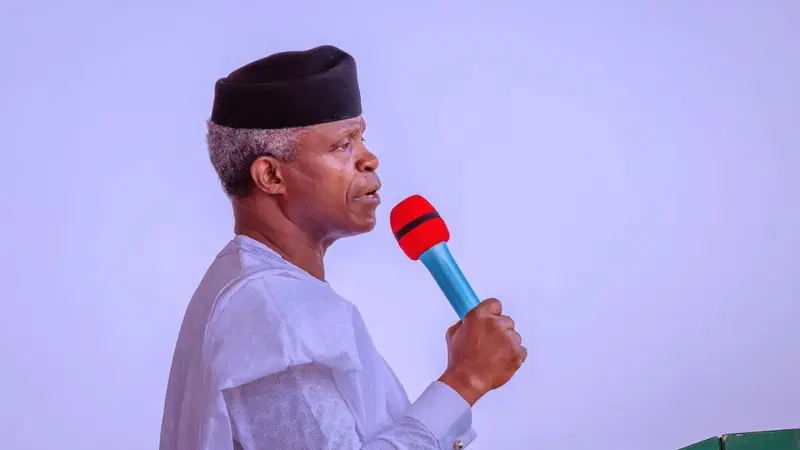
Former Vice President, Prof. Yemi Osinbajo, has stated that any reorientation efforts aimed at bringing Nigerians together must be intentional and deliberately pursued.
Prof Osinbajo made the disclosure at a dialogue organised by the Justice Research Institute ltd/Gte in partnership with the National Institute for Policy and Strategic Studies, NIPSS, Kuru, to examine conflict, polarisation and social cohesion in north central Nigeria with broader regional perspectives.
The conference themed “Countering Polarisation and Rebuilding Civic Cohesion in North-Central Nigeria: Beyond Tribe and Faith—Reclaiming Our Shared Stories,” brought together stakeholders to explore practical approaches to addressing divisions and rebuilding trust among communities.
The former vice president who spoke after story telling session by victims of conflicts from Plateau, Benue and Niger states said whether it was South Africa through its Truth and Reconciliation Commission or Rwanda, the process of reconciliation was deliberate.
“In Rwanda, over a million people were slaughtered with machetes, not even guns. Can you imagine how horrendous that must have been? A million people slaughtered with machetes. Yet, they came back together because there was a deliberate and intentional desire, particularly on the part of the leadership and government, to ensure that people came together. Today, by and large, those divisions have been addressed, and people are working together.
“The Tutsis and Hutus are working together. In fact, you must not even mention tribe in certain engagements,” he said.
According to him, there is need for deliberate and intentional reconciliation and peacebuilding in Nigeria, which can only be achieved through collaboration between government, civil society groups and religious leaders.
“Much will depend on the elite of our country: the religious elite, the political elite and other influential members of society. Civil society must come together, but government must lead because political will is absolutely crucial,” Osinbajo said.
He also stressed that there must be consequences for actions that amount to wrongdoing and offences against the state.
“If there are no consequences, there can be no meaningful rebuilding. As they say, one of the most important building blocks of peace is justice. Justice itself requires restoration wherever necessary,” he noted.
Citing the issue of land grabbing, Osinbajo said land must be restored to those from whom it has been taken.
“That process is important because it helps to rebuild what people have lost. Wherever compensation is necessary and wherever restoration is possible, it must be done. If it is not done, we leave an open wound. You cannot simply tell people to forget, especially when they can see that restoration is still impossible,” he said.
Osinbajo said the call for penalties for wrongdoing leads to a bigger problem — the state of the justice system in Nigeria.
“The administration of justice system is broken and requires urgent attention. Consider the figures for people incarcerated in Nigeria. We have about 26,000 convicted prisoners — people who have gone through the judicial process and have been convicted.
“Nigeria has a population of about 200 million, yet only about 26,000 people have been convicted. The United States has a population of about 300 million and has over two million convicted prisoners. The United Kingdom has a population of about 67 million and over 80,000 convicted prisoners. That is more than three times the number we have.
“This suggests that something may be wrong with our criminal justice system. Of course, there are two possibilities: either we are remarkably well-behaved people, which might explain the low number, or there is something wrong with the system,” he said.
He said the same problem extends to civil cases, noting that a survey by the Justice Research Institute showed that civil and commercial cases that go to the Supreme Court take an average of 13 to 15 years to resolve.
Recalling his time as Attorney General of Lagos State in 1999, Osinbajo said his administration conducted a survey among 200 lawyers who had practised for at least 10 years in Lagos State High Court, and 89 per cent of them said judges were notoriously corrupt.
“From 1967 to 1999, nobody had even reprimanded a judge or magistrate for corruption. During that time, judges were earning N67,000 a month. We asked one judge about his financial responsibilities — a son in the US with $12,000 tuition and another son at the University of Lagos.
“One of the judges stopped the discussion and said, ‘Let it end. You know this thing you are doing is rubbish. You are pretending to pay us; we too were pretending to work. You know that this thing you are doing is not honest.’”
He said his administration decided that judges must be paid wages sufficient to meet their needs, including providing a personal home in any part of Lagos for life, and taking discipline seriously.
“About 220 magistrates were dismissed within six or seven months as part of the reform. Three judges also lost their jobs. In 2007, we conducted the same survey again. Zero per cent of the lawyers said the judges were corrupt. We had moved from 89 per cent to zero per cent. It was not because we brought angels down from heaven. We had to address the issues truthfully and honestly,” he said.
Osinbajo said the compact developed from the series of dialogues, including one held in Enugu for the South-East, represents aspirations for national dialogue.
“While leadership and political will are crucial, the will of those of us seated in this room is equally important. We are privileged. We are the elite of our society. We shape opinions and influence thinking in many ways. What we agree to do as individuals and as a group will be very important in determining how things progress in our country,” he added.
Meanwhile, the Chairman of the conference, the Emir of Lafia, His Royal Highness Justice Sidi Bage called for discussions that would produce meaningful solutions, promote justice and address the underlying causes of conflict.
He urged participants to embrace new perspectives and recognise their shared responsibility for building peaceful communities.
Similarly, the Co-Chairman of the conference and Secretary-General of Jama’atu Nasril Islam, Professor Khalid Aliyu, observed that rebuilding civic cohesion remains a difficult task in some communities, partly because of misleading messages from some religious leaders. He stressed the importance of responsible religious leadership in promoting understanding and peaceful coexistence.
Earlier the Director-General of NIPSS, Professor Ayo Omotayo in his welcome address urged participants to approach discussions with open minds and without prejudice, stressing the need for practical recommendations that would improve relationships and secure a better future for communities in Plateau and Benue States.
Presenting his research findings, Associate Professor Ahmed Garba identified three critical areas for addressing polarisation: strengthening dialogue mechanisms, promoting shared economic interests through improved livelihoods, and tackling misinformation, which he said accelerates violence.