

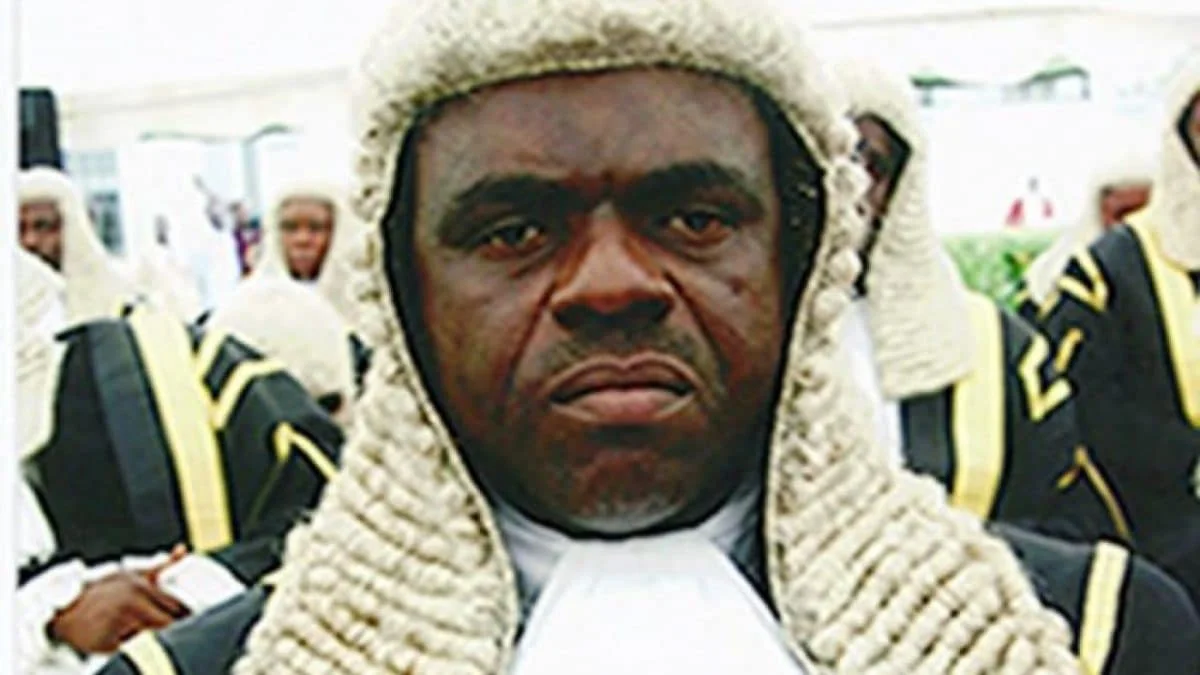
The Chief Judge of the Federal High Court of Nigeria, Hon. Justice John Terhemba Tsoho, has disclosed that judges of the court disposed of 16,019 cases out of 181,924 pending matters during the 2024/2025 legal year.
Delivering his remarks at the opening of the 2025/2026 Special Legal Year in Abuja, Justice Tsoho noted that despite the progress, 165,905 cases remain pending across the court’s divisions nationwide.
According to the Chief Judge, at the close of the 2023/2024 legal year, 161,999 cases were carried over, while during 2024/2025, 19,925 new cases were filed, bringing the total to 181,924 matters.
Of these, 16,019 cases were concluded, comprising: 3,113 civil cases, 5,818 criminal cases, 3,724 motions and 3,364 fundamental rights cases
Pending matters now stand at: 44,650 civil cases, 44,078 criminal cases, 46,228 motions and 30,949 fundamental rights enforcement applications
Justice Tsoho emphasized that these figures reflect the judiciary’s commendable performance in the face of its expansive jurisdiction and heavy workload. He further highlighted the judiciary’s role in Nigeria’s improved rating by the Financial Action Task Force (FATF), underscoring the broader impact of judicial efficiency on national governance.
He announced that the e‑filing system has commenced in the Lagos Division, with plans to extend it to all divisions nationwide. Additionally, the process of appointing 14 new judges to the Federal High Court is at an advanced stage, following approval by the Chief Justice of Nigeria (CJN) and the National Judicial Council.
In her address, the Chief Justice of Nigeria (CJN), Hon. Justice Kudirat M.O. Kekere‑Ekun, cautioned that public confidence in the judiciary remains fragile, stressing that perceptions of opacity or inefficiency can undermine even sound judicial decisions.
She reaffirmed that judicial independence is the lifeblood of democracy, not a mere ideal, but a discipline requiring courage, restraint, and fidelity to the law. She commended judges who continue to uphold their oath with dignity, fairness, and professionalism, while acknowledging the growing complexity of the court’s workload.
The Federal High Court exercises jurisdiction over matters relating to finance, revenue, civil service, and other critical sectors. It also shares concurrent jurisdiction with the High Court of the Federal Capital Territory and State High Courts in fundamental rights enforcement, pursuant to Section 46(1) of the 1999 Constitution.