

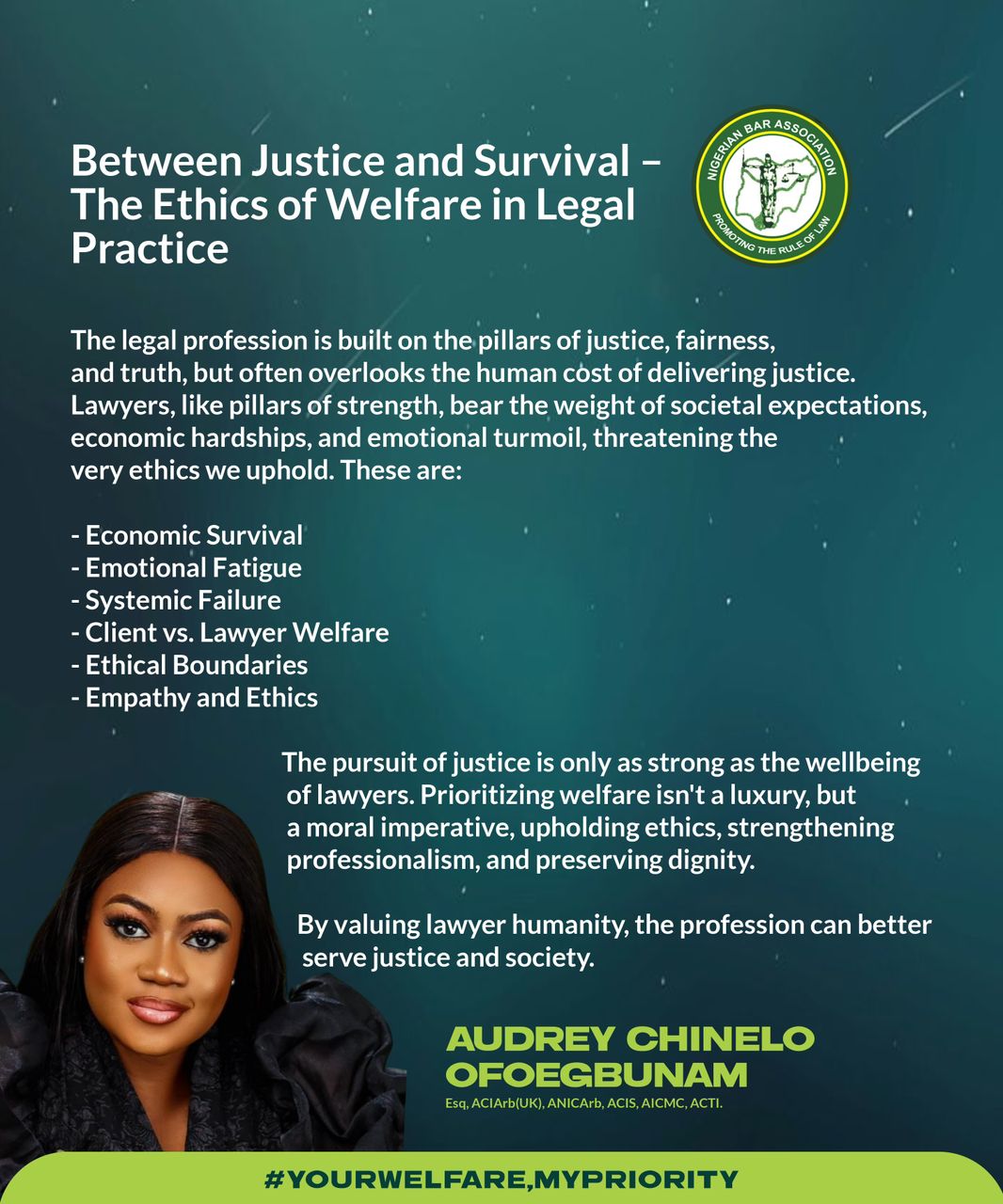
By Chinelo Audrey Ofoegbunam
Introduction
Every legal system speaks passionately about justice, fairness, and the pursuit of truth. But very few ever pause to ask a quieter, more uncomfortable question: What is the cost of delivering justice to those who administer it?
In Nigeria, the lawyer is often imagined as an unshakable pillar—calm in turbulence, brilliant under pressure, and courageous in the face of conflict. Yet beneath the robe and rhetoric lies a human being navigating the same anxieties, economic hardships, emotional storms, and survival pressures that afflict the society they are sworn to serve.
The legal profession demands moral clarity, intellectual discipline, and ethical fortitude. But what happens when the lawyer’s welfare becomes a battlefield? When financial instability, emotional exhaustion, or systemic neglect begins to eat into the very values the profession upholds?
This is where the conversation about ethics becomes inseparable from welfare. Not as parallel interests, but as intertwined realities. A lawyer who is underpaid, overworked, unsupported, or emotionally strained does not merely suffer personally—justice itself becomes compromised.
This article explores the unspoken terrain between justice and survival—the complex, delicate space where the demands of the law intersect with the needs of the human being who practices it. Here, the ethical dilemmas of modern legal work emerge not from dramatic scandals, but from everyday struggles: the struggle to remain objective while exhausted, to uphold fairness while financially unstable, to maintain integrity while fighting to survive.
When welfare is overlooked, ethics becomes fragile. And when ethics bends, justice trembles.
This is the real story: what it truly means to practice law in a world where the pursuit of justice often collides with the burden of survival.
1. The Ethical Weight of Economic Survival – When Duty Meets Desperation
Every lawyer knows that the legal profession is built on high ethical expectations. Yet, these expectations rest on an assumption rarely spoken aloud—that the lawyer is stable enough to uphold them. What happens when that stability begins to shake?
Unlike professions with predictable salaries or corporate safety nets, legal practice—especially in Nigeria—can feel like walking on shifting sands. Income is irregular. Cases delay. Clients disappear after receiving advice. Some promise to pay “after the judgment,” others ask for “professional favours,” and many assume lawyers do not need to be paid promptly because “you people are already rich.”
In such an unpredictable landscape, ethical dilemmas grow quietly, almost naturally:
● Should a lawyer take every case—even those outside their competence—just to survive?
● Should they undercharge, overcharge, or accept unstable payment methods?
● Should they juggle too many cases, knowing that quality may suffer?
Most lawyers do not intend to bend ethics; survival simply begins to whisper louder than discipline. Economic instability becomes an invisible hand tugging at professional judgment. And the tragedy is that the system rarely acknowledges this struggle.
For many lawyers, the real ethical fight does not happen in the courtroom—it happens in the wallet.
2. The Burden of Emotional Fatigue – When a Tired Mind Makes Tougher Choices
The legal profession demands clear judgment, emotional distance, and intellectual sharpness. But what happens when the lawyer is emotionally drained long before they enter a courtroom?
The pressure to perform, the expectation of stoic perfection, and the constant exposure to conflict create emotional weariness that the public never sees. Lawyers absorb the anger, trauma, and desperation of clients. They carry the stress of deadlines, adjournments, and judicial unpredictability. They battle self-doubt, insomnia, and a constant fear of error.
Emotional fatigue does more than exhaust the spirit—it distorts ethical clarity.
A weary mind:
● becomes irritable with clients,
● rushes through preparation,
● loses patience in negotiation,
● overlooks details,
● struggles to maintain objectivity.
These are not ethical failures—they are symptoms of a system that forgets the lawyer is human.
A profession that depends on clear thinking must also protect the emotional welfare of its practitioners. Without this, ethics becomes a luxury reserved for the well-rested, the well-supported, and the fortunate few.
3. Dignity as a Moral Imperative – Why Welfare Is an Ethical Right, Not a Privilege
There is an unspoken truth in the legal profession: dignity fuels integrity.
When a lawyer works in conditions that erode their dignity—poor infrastructure, unsafe environments, delayed remuneration, disrespect from institutions—their ethical foundation begins to weaken. Not out of malice, but out of erosion.
Dignity is more than pride; it is the emotional scaffolding that allows a lawyer to stand firmly by their values. A lawyer who feels respected, supported, and acknowledged can practice ethically with courage. A lawyer who feels invisible, dismissed, or exploited must fight twice as hard to maintain professional integrity.
Here lies the moral paradox:
The legal system demands the highest standards of ethics from lawyers while offering the lowest standards of welfare in return.
Welfare is not softness. It is not an entitlement. Welfare is the oxygen that keeps ethical practice alive. When a lawyer’s dignity is protected, justice breathes easier.
4. When Institutions Fail – The Ethical Burden of a Broken System
A lawyer’s integrity is closely tied to the system they operate within. But what happens when the system itself becomes an obstacle?
In many parts of Nigeria, the infrastructure of justice is worn down—missing files, malfunctioning courtrooms, endless adjournments, insufficient staffing, and digital gaps. These are not mere inconveniences; they create daily ethical dilemmas for lawyers trying to do honest work.
When a case is adjourned five times because a court lacks electricity, who carries the ethical blame? When a lawyer cannot file a process because the registry is closed, who bears responsibility for the client’s dismay? When delays harm justice, the lawyer is often blamed first, even though they are fighting the same broken machinery.
Systemic failure becomes an ethical trap: lawyers must compensate for institutional weaknesses while still upholding professional standards. It is an exhausting, invisible battle—one where the lawyer must protect clients from the very system meant to protect them.
In such a landscape, the ethical burden should not fall solely on the practitioner. A legal system that expects excellence from lawyers must offer structural support in return.
5. The Client’s Welfare vs. the Lawyer’s Welfare – A Delicate Balancing Act
Every lawyer enters the profession with the instinct to protect clients. It is part of the oath, part of the culture, part of the heart of legal practice. But this noble calling often becomes a source of ethical tension when the lawyer’s own welfare is at stake.
Clients come with urgent needs, emotional stories, and high expectations. They want prompt responses, long consultations, and vigorous representation—even when lawyers are exhausted or overwhelmed. Some expect discounted fees. Others expect free legal services entirely.
The internal dilemma follows:
● Do I stretch myself to meet this client’s needs at the expense of my health?
● Do I lower my fees to help them—even if it means I can’t meet my own financial obligations?
● Do I continue representing them even when the emotional toll becomes unbearable?
The lawyer becomes a caretaker, sometimes to their own detriment.
Balancing client welfare with personal welfare is not selfishness—it is ethical preservation. A lawyer who sacrifices themselves completely eventually has nothing left to give. And a depleted lawyer cannot offer sound, ethical representation. True ethics require boundaries. The law may require diligence, but it does not demand self-destruction.
6. Ethical Boundaries Under Pressure – Surviving Without Compromise
The legal profession is one of constant moral negotiation. But the negotiation becomes harder when survival is involved. In times of financial strain or emotional distress, the temptation to cut corners grows quietly:
● taking cases far outside one’s competence,
● rushing preparation to manage workload,
● accepting undervalued or exploitative client terms,
● avoiding difficult conversations with clients,
● stretching beyond ethical limits just to retain business.
These are not acts of corruption—they are symptoms of pressure.
Most lawyers do not want to compromise; they simply fear losing clients, losing income, or losing relevance. The profession often praises resilience but seldom acknowledges that resilience without support becomes desperation.
Ethical boundaries are like fences—they protect the lawyer as much as they protect the client. But fences weaken when the ground beneath them is unstable.
To survive without compromising values, the lawyer must learn to:
● say no without guilt,
● choose quality over quantity,
● prioritize competence over desperation,
● recognize early signs of ethical stress,
● seek support rather than silence.
In a demanding environment, ethics require conscious, continuous reinforcement.
7. A Collective Moral Duty – Why the Legal Community Must Protect Its Own
Ethics is not an individual sport; it is a collective responsibility. A lawyer’s welfare should not depend on luck, privilege, or personal networks. The legal community—senior lawyers, colleagues, law firms, bar associations, and even judicial institutions—has an ethical duty to safeguard the wellbeing of those who serve justice.
This duty is more than mentorship or professional guidance. It is moral solidarity.
It means creating an environment where:
● young lawyers are not exploited under the guise of “training,”
● struggling lawyers are not shamed but supported,
● welfare conversations are not seen as weakness but wisdom,
● dignity is protected as fiercely as professional standards.
A thriving justice system is built not only on strong laws, but on the wellbeing of the people who interpret and apply them. When lawyers uplift one another, the entire community benefits.
The legal profession is a family—complex, traditional, and sometimes difficult—but still a family. And in any family, care is not optional; it is an ethical obligation.
8. Welfare as Professional Ethics – A New Lens for a New Era
For decades, welfare in legal practice has been treated as a personal concern, something individual lawyers must manage on their own. But in reality, welfare is not a side issue—it is an ethical pillar. A lawyer whose physical, emotional, or financial wellbeing is compromised cannot consistently uphold the standards the profession demands.
Today’s legal landscape requires a shift in mindset:
● Welfare is not an indulgence; it is a professional necessity.
● A lawyer’s wellbeing is not separate from their ethical duties; it shapes them.
● A broken system cannot demand unbroken lawyers.
If a surgeon must be well-rested to operate safely, then surely a lawyer must also be supported to think clearly, advise responsibly, and advocate ethically. Welfare becomes not only a matter of compassion but a matter of professional integrity.
When we view welfare through the lens of ethics, it transforms from a personal struggle into a collective mandate.
9. The Human Duty Behind the Legal Duty – Why Empathy Must Inform Ethics
In the world of law, empathy often hides in the background. The profession is structured around logic, precedent, and objectivity—qualities that ensure fairness. Yet, a lawyer without empathy can easily lose sight of the human condition, including their own.
Empathy is not softness; it is awareness. It is the understanding that behind every legal problem is a human being—and behind every lawyer is one too.
When lawyers embrace empathy:
● They listen better.
● They negotiate more wisely.
● They manage conflicts with less aggression.
● They recognize when their own wellbeing needs attention.
Empathy also encourages a more humane legal ecosystem. A senior lawyer who remembers their struggles is more likely to treat juniors with dignity. A colleague who sees signs of burnout is more likely to intervene. A judge who recognizes systemic pressures may show more patience.
Ethics without empathy becomes cold; empathy without ethics becomes unstable. The two are intertwined—each strengthens the other.
10. Reimagining the Future – A Profession Where Justice and Welfare Coexist
The time has come to reimagine what legal practice should look like—a profession where justice is not built on the suffering of its practitioners. A future where welfare is not a privilege granted to the fortunate, but a right accessible to all lawyers, regardless of region, rank, or resources.
This future rests on three pillars:
1. Cultural Change – A shift away from glorifying struggle and toward normalizing balance, boundaries, and wellbeing.
2. Structural Reform – Pushing for institutional improvements—better court conditions, digital access, safer environments, fair compensation models.
3. Ethical Evolution – Embedding welfare considerations into ethical rules, mentorship frameworks, and professional expectations. In such a future, lawyers would practice not from a place of depletion, but from a place of power—ethical power, emotional power, intellectual power. A legal profession that protects its practitioners will create a justice system that protects the society.
Conclusion
In the heart of legal practice lies an unspoken truth: the pursuit of justice is only as strong as the wellbeing of the people who fight for it. When lawyers struggle silently—financially, emotionally, or structurally—their ability to serve justice becomes strained. And when justice suffers, society suffers with it.
Welfare is not an afterthought. It is not a luxury. It is not a favour.
Welfare is a moral imperative—one that upholds ethics, strengthens professionalism, and preserves the dignity of the legal practitioner.
The journey between justice and survival is a delicate one. But when the profession begins to value the humanity of the lawyer as much as the sanctity of the law, a new balance emerges—one where justice thrives because the people who deliver it are supported, respected, and empowered.
In the end, the lawyer’s greatest strength is not perfection, but humanity. And a profession that honours that humanity will stand taller, last longer, and serve justice more faithfully than ever before.
Connect with me on Social Media:
X: CIAO Legal
LinkedIn: Chinelo Audrey Ofoegbunam
Instagram: CIAO Legal
Facebook: Chinelo Ofoegbunam