

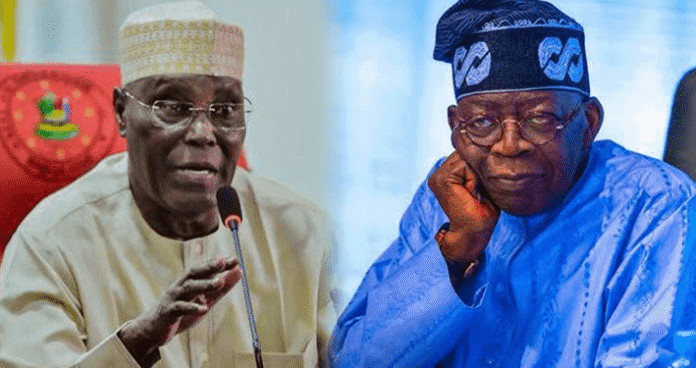
An All Progressives Congress (APC) chieftain and public affairs analyst, Dr George Agbakahi, has described former Vice President Atiku Abubakar’s fresh court action challenging President Bola Ahmed Tinubu’s qualification for the 2027 presidential election as “lawfare” and an attempt to use the judicial process to achieve a political objective.
In a statement he issued to reporters in Owerri, the Imo State capital, Agbakahi said the development represented another attempt to turn a political contest into a judicial battle, describing it as an example of what he called “judicialised politics”.
Atiku, the presidential candidate of the African Democratic Congress (ADC), filed the suit at the Federal High Court in Abuja on Friday, 14th August, 2026.
He challenged Tinubu’s qualification over an alleged discrepancy in the name on his NYSC discharge certificate. A”
According to the APC chieftain, the issue should be determined strictly on the basis of evidence and the applicable provisions of Nigerian law, rather than through political statements or attempts to internationalise a domestic legal dispute.
“This recent drama by Atiku is not about justice or constitutional scrutiny.
This is a textbook case of lawfare, the strategic use of legal systems and courts as weapons to damage, delegitimise, or hinder a political opponent,” he said.
Agbakahi said the constitutional provision being relied upon in the suit must be distinguished from the law governing the proof of an alleged criminal offence. He pointed specifically to Section 137(1)(j) of the 1999 Constitution, which provides that a person shall not be qualified for election to the office of President if “he has presented a forged certificate to the Independent National Electoral Commission.” He argued that the provision establishes a ground of disqualification but does not, by itself, establish that a particular document is forged. The allegation must still be proved by evidence before the court.
He further cited Section 135(1) of the Evidence Act 2011, stressing that the provision—not the Constitution—governs the standard of proof when the commission of a crime is directly in issue. It provides that “If the commission of a crime by a party to any proceeding is directly in issue in any proceeding, civil or criminal, it must be proved beyond a reasonable doubt.” Agbakahi said this was important because forgery is a criminal offence and therefore cannot be established merely by pointing to a discrepancy in the name appearing on a document.
Agbakahi also drew attention to Section 135(2) of the Evidence Act, which provides that “The burden of proving that any person has been guilty of a crime or wrongful act is… on the person who asserts it.” He argued that the implication was that the party asserting that a document is forged bears the burden of establishing the allegation with the evidence required by law. “An allegation of forgery is criminal in nature and must be proved in accordance with the applicable standard of proof, not by mere name variance, not by suspicion, and certainly not by media posts,” he said.
On the meaning of forgery itself, the APC chieftain referred to Section 465 of the Criminal Code Act, which provides that “A person who makes a false document or writing knowing it to be false, and with intent that it may in any way be used or acted upon as genuine…” is said to forge the document. Agbakahi argued that the statutory definition, therefore, goes beyond the mere existence of a different or inconsistent name on a document and requires evidence establishing the elements of the offence, including knowledge and the requisite intention.
He consequently questioned the evidence available to support the claim, asking: “Where is the witness from the NYSC saying that the NYSC did not issue the certificate? Where is the forensic document examiner’s report? Where is even the certified true copy of the allegedly forged document?” He said it was difficult to logically characterize a document as conclusively forged while simultaneously seeking a court order from INEC to obtain it and establish its authenticity or otherwise. “One cannot reasonably assert the falsity of a document while, at the same time, seeking a court order to obtain the very document said to be forged,” he said, describing the development as the “Atiku Circus.”
Agbakahi also referred to the Supreme Court’s earlier consideration of Atiku’s challenge to the 2023 presidential election, arguing that allegations concerning forgery had previously been canvassed and that the evidential burden had not been discharged. He said the attempt to revive the controversy for the 2027 election cycle amounted to what he described as “res judicata: a matter already adjudicated.” He maintained that the courts should be allowed to determine the present case on its own evidence rather than through political campaigns or external pressure.
The APC chieftain equally criticised the reported petition to the European Commission in Brussels over the same controversy, arguing that the qualification of a Nigerian presidential candidate is a matter for Nigeria’s constitutional and judicial institutions. “The European Commission has no jurisdiction over the qualification of a Nigerian presidential candidate,” he said, questioning why a matter already before a Nigerian court should simultaneously be taken to a foreign political institution. Quoting Senator Basiru, Agbakahi added: “Atiku has nothing to offer Nigerians, and he knows that he will be rejected at the polls. That is why he is looking for a shortcut. But there’s no shortcut to power.” He concluded: “We will meet Atiku on the ballot, not in Brussels.”