

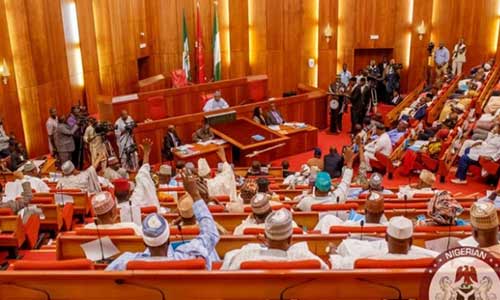
The Senate yesterday passed for second reading a Bill seeking to repeal and re-enact the Armed Forces Act to provide for a modern, constitutionally compliant, and operationally responsive legal framework for the Nigerian military.
The proposed legislation, titled: “A Bill for an Act to Repeal the Armed Forces Act and to re-enact a modern, constitutionally compliant and operationally responsive legal framework for the Armed Forces of the Federal Republic of Nigeria, and for Related Matters, 2025”
was sponsored by the Chairman of the Senate Committee on Army, Abdulaziz Yar’Adua (APC, Katsina Central).
In his lead debate, Yar’Adua said the existing Armed Forces Act, originally derived from military decrees of the 1960s and last consolidated in 2004, no longer reflects the realities of Nigeria’s constitutional democracy and complex security challenges.
“The Armed Forces of Nigeria remain the cornerstone of our sovereignty and national security,” Yar’Adua said.
“They have stood gallantly in defence of our nation, from combating insurgency and terrorism to peacekeeping missions across Africa.
“However, our military law has not kept pace with the evolving defence environment.”
The Katsina lawmaker explained that the Bill seeks to align the governance of the Armed Forces with constitutional principles, democratic accountability, and international best practices.
He said it also aims to modernise disciplinary procedures, operational structures, and welfare provisions for service personnel.
According to him, obsolete fines, such as N200 and N500 penalties, would be replaced with percentage-based sanctions tied to officers’ salary levels, while fair hearing provisions and expanded rights for non-commissioned officers would be introduced to boost morale and ensure justice.
Senate seeks urgent construction of Ode–Omifufu–Ofosu road to link Ondo, Edo
Yar’Adua noted that many democracies, including those of the United States, the United Kingdom, and South Africa, have reformed their military laws to promote professionalism, accountability, and respect for human rights.
“Nigeria cannot afford to lag,” he said.
Senator Ali Ndume (APC, Borno South) supported the Bill, describing the proposed reform as long overdue.
“As we advance in our democracy, it is necessary to align our Armed Forces with modern laws that reflect transparency and professionalism,” he said.
Also, Senator Tahir Monguno (APC, Borno North) said the legislation would strengthen civilian oversight of the military and ensure that military authorities operate within democratic frameworks.
“This Bill seeks to bring our military laws in tandem with international best practices and under the control of democratically elected institutions,” Monguno said.
Senator Sampson Ekong (APC, Akwa Ibom South) described the proposed Bill as a “profound reform initiative” aimed at deepening the nation’s defence policy framework and reinforcing professionalism within the Armed Forces.
The Bill was passed for second reading after Deputy Senate President Barau Jibrin, who presided over the plenary, put it to a voice vote.
Barau referred the Bill to the Senate Committees on Defence, Army, Air Force, and Navy for further legislative work, with a directive to report back within four weeks.