

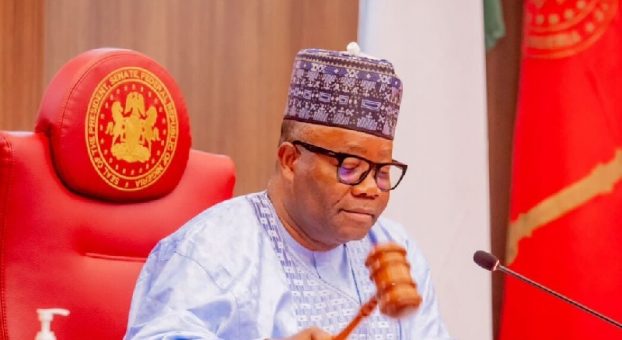
Senate President Godswill Akpabio and a criminologist, Professor Etannibi Alemika, have expressed differing views on the proposed establishment of state police.
Akpabio defended the initiative as a measure to strengthen Nigeria’s security architecture while Alemika warned against possible political abuse. BuyMaps
Alemika cautioned that state police could worsen insecurity if established without adequate safeguards against political interference, particularly in states where governors wield considerable influence over public institutions.
Akpabio, however, maintained that the proposed state police system would complement the existing federal police structure rather than replace it.
He added that the arrangement would operate under regulatory safeguards and federal oversight.
The exchange occurred on Monday at the 10th convocation of the National Institute for Legislative and Democratic Studies (NILDS) and the University of Benin (UNIBEN) in Abuja, where Alemika delivered a lecture titled State Police in Nigeria: Issues, Challenges and Prospects.
The professor argued that decentralising policing without addressing weaknesses in governance and the wider social conditions contributing to insecurity would not produce lasting results.
“The solution to Nigeria’s insecurity lies not simply in state police or federal police, but in good governance,” he said. BuyMaps
He identified unemployment, poverty, inequality, inadequate healthcare, poor education and environmental degradation as threats to human security, arguing that the country’s security challenges extended beyond physical attacks, loss of lives and destruction of property.
The criminologist expressed concern that governors could use state-controlled police formations to advance political interests if effective institutional safeguards were not established.
He questioned whether existing constitutional provisions would adequately prevent interference, given governors’ influence over state legislatures, judiciaries and electoral commissions.
Alemika urged the National Assembly to ensure meaningful public participation in the constitutional amendment process, warning that the implications of the proposed reform demanded careful consideration.
“A nation has thousands of years ahead of it. We should not rush into decisions that could have far-reaching consequences,” he said.
He argued that decentralisation should not be treated as an automatic solution to Nigeria’s security challenges, noting that its effectiveness would depend on the quality of governance, institutional independence and the ability to coordinate security operations.
The professor also distinguished between the police as a formal institution and policing as a broader social function.
He identified families, schools, religious organisations, communities, vigilante groups and government agencies as participants in maintaining order and addressing security concerns.
According to him, Nigeria already operates a system of plural policing, making coordination among existing security providers an important part of any reform.
He cited Sweden, the Netherlands, Scotland, Norway and Denmark as examples of jurisdictions that had consolidated police structures to strengthen coordination and improve administration.
Alemika said Nigeria should study international experiences carefully rather than assume that establishing additional police formations would automatically improve security.
The professor advocated a broader approach to security reform, insisting that policymakers should address the shortcomings of the country’s existing policing arrangements alongside the social and governance problems that contribute to insecurity.
He recommended federal support for police training infrastructure and alternative policing arrangements for states unwilling or unable to establish separate police forces.
He also called for reforms encompassing formal security agencies and community-based security providers, arguing that improved coordination would strengthen responses to threats.
Alemika maintained that Nigeria needed policing reform rather than merely police reform, with greater attention to institutional accountability, public trust and the underlying causes of insecurity. BuyMaps
Responding to Alemika’s concerns, Akpabio disagreed with the assertion that adequate public hearings had not been held on the proposed state police legislation.
Discover more
Follow Politics
POLITICS
Political
Represented by Deputy Senate President Barau Jibrin, the Senate President said hearings were conducted in Abuja and across the six geopolitical zones, giving Nigerians opportunities to contribute to the proposal. BuyMaps
He maintained that the proposed state police system was designed to strengthen the existing security architecture by allowing state-level policing to complement federal operations.
“The federal police will remain intact. The objective is to complement the work of the existing police force,” Akpabio said.
He added that state police would operate under regulatory safeguards and federal oversight, with clearly defined limits on their weapons and powers.
According to him, the proposed arrangement would not alter the existing responsibilities of the federal police.
Akpabio’s defence centred on the position that state police would supplement, rather than displace, the federal force, while safeguards would govern their operations.
Discover more
Sports News
NEWS
African News
The differing positions underscore the central questions surrounding the proposed reform: how to improve local responses to insecurity while preventing political interference, ensuring accountability and maintaining effective coordination between federal and state security institutions.