


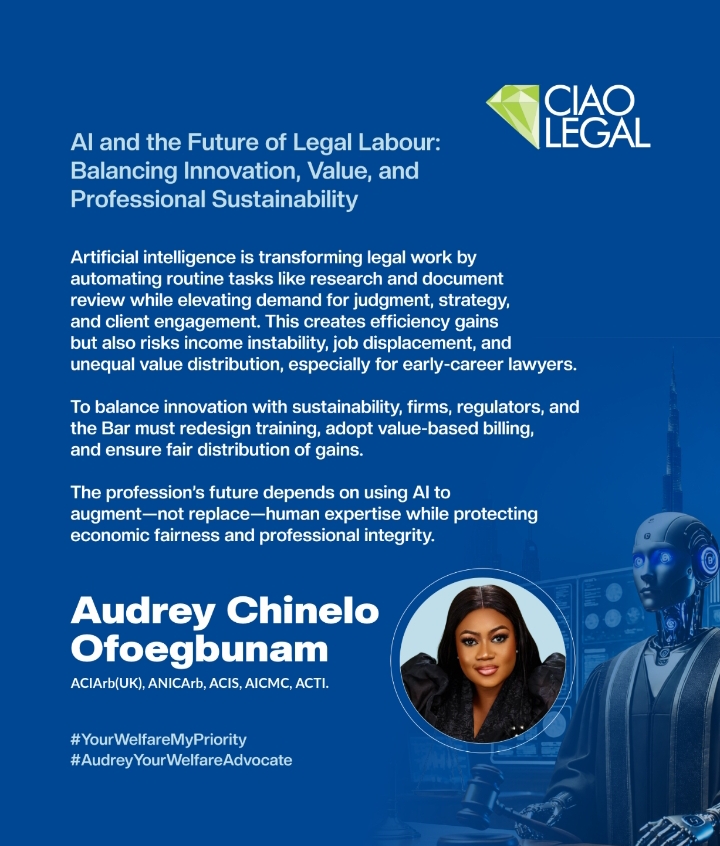
By Audrey Chinelo Ofoegbunam
Introduction
Artificial intelligence is rapidly reshaping the landscape of legal practice. What began as a set of efficiency-enhancing tools supporting research, document review, and administrative workflows has evolved into a transformative force with the potential to redefine how legal services are produced and delivered. The pace of this change is accelerating, driven by advances in machine learning, data processing, and automation.
This evolution presents a dual reality. On one hand, AI offers unprecedented opportunities to improve efficiency, reduce costs, and expand access to legal services. On the other hand, it introduces uncertainty into the traditional structure of legal labour. Tasks that once formed the foundation of professional work particularly at the entry and mid-level are increasingly susceptible to automation.
As a result, concerns about income stability, job displacement, and the redefinition of professional value are becoming more pronounced. Lawyers are beginning to question not only how they work, but what aspects of their work will remain economically viable in an AI-assisted environment. The issue is no longer confined to technology adoption; it extends to the sustainability of legal careers.
AI must therefore be understood not only as a technological shift, but as an economic and labour issue. Its impact touches compensation models, career pathways, and the distribution of value within the profession. Without deliberate intervention, efficiency gains may not be equitably shared, and certain segments of the profession may bear disproportionate risk.
The challenge, then, is to strike a balance embracing innovation while proactively protecting the economic interests of legal practitioners. The future of the profession will depend on how effectively it navigates this intersection between technological advancement and labour sustainability.
1. The Changing Nature of Legal Labour
Legal labour has traditionally been structured around a combination of research, drafting, due diligence, and advisory work. These functions have formed the backbone of professional development, particularly for early-career lawyers, and have been closely tied to prevailing billing models.
However, the rise of artificial intelligence is driving a segmentation of legal tasks. Routine, repetitive, and data-intensive functions such as document review, contract analysis, and large-scale research are increasingly automatable. In contrast, high-value functions such as strategic advisory, complex problem-solving, advocacy, and client relationship management remain firmly within the domain of human expertise.
This segmentation is reshaping how legal work is organized and valued. The traditional model, which often relied on the accumulation of billable hours, is being challenged. As AI reduces the time required to complete certain tasks, time-based billing becomes less reflective of value delivered. This is accelerating a shift toward value-based service delivery, where clients pay for outcomes, insight, and efficiency rather than duration of effort.
Consequently, what clients are willing to pay for is evolving. Efficiency is increasingly assumed, not rewarded. The premium is shifting toward judgment, experience, and the ability to navigate complexity. Lawyers are therefore required to demonstrate value beyond execution focusing on interpretation, strategy, and trust.
The implications of this shift vary across career stages. Junior lawyers, whose roles have traditionally centered on repetitive tasks, face the greatest disruption as these functions become automated. Mid-level practitioners must adapt by deepening their expertise and transitioning toward more strategic roles. Senior lawyers, while less exposed to direct displacement, must recalibrate how they generate and demonstrate value in a more efficiency-driven environment.
In effect, AI is not eliminating legal work, but transforming its composition. The challenge for the profession is to ensure that this transformation does not erode economic stability, but instead creates pathways for sustainable and meaningful engagement at every level.
2. AI Capabilities in Legal Practice
Artificial intelligence is increasingly embedded in core areas of legal practice, enhancing both the speed and scope of professional work. Its capabilities are most evident in functions that involve large volumes of data, pattern recognition, and repetitive analysis.
Document review and contract analysis are among the most advanced applications. AI-powered tools can scan thousands of documents, identify key clauses, flag inconsistencies, and highlight potential risks within a fraction of the time required for manual review. Similarly, legal research automation enables rapid retrieval and synthesis of relevant authorities, significantly reducing the time spent on foundational tasks.
Predictive analytics is also gaining traction, particularly in litigation and risk assessment. By analyzing historical case data, judicial tendencies, and procedural outcomes, AI systems can provide probabilistic insights that inform strategy. While not determinative, these insights offer an additional layer of decision-support in complex matters.
Drafting assistance and workflow optimization tools further streamline legal processes. Automated templates, intelligent drafting platforms, and integrated case management systems reduce duplication of effort and enhance consistency across documents. Routine communications, filings, and procedural steps can be standardized, allowing lawyers to focus on higher-level engagement.
The cumulative advantages of these capabilities are clear: increased speed, scalability, and cost-efficiency. Tasks that once required extensive human input can now be completed more quickly and, in some cases, more accurately. This enhances productivity and enables legal service providers to handle larger volumes of work.
However, these capabilities are not without limitations. AI systems operate within defined parameters and depend on the quality of data they are trained on. Issues of accuracy, contextual understanding, and nuance remain significant. Legal judgment particularly in complex or novel situations cannot be fully replicated by automated systems.
Accountability is another critical concern. AI-generated outputs must be reviewed, validated, and ultimately owned by legal practitioners. Responsibility for advice cannot be delegated to technology. Ethical considerations, including bias in data and transparency in decision-making, further underscore the need for careful oversight.
In essence, AI is a powerful tool but not a substitute for professional judgment. Its value lies in augmentation, not replacement.
3. Economic Risks to Legal Practitioners
While AI enhances efficiency, it also introduces tangible economic risks for legal practitioners, particularly within traditional billing and employment structures.
One of the most immediate effects is the reduction in billable hours for routine tasks. As document review, research, and drafting become faster through automation, the time required to complete these activities decreases. In a system where revenue is closely tied to hours billed, this creates a direct impact on income generation.
This dynamic contributes to downward pressure on fees. Clients, aware of technological efficiencies, increasingly expect faster turnaround times at lower cost. What was once considered labor-intensive and priced accordingly is now viewed as streamlined. As a result, the perceived value of certain legal services may decline, even as their importance remains unchanged.
Entry-level roles are particularly vulnerable in this context. Junior lawyers have traditionally developed their skills through repetitive, process-driven tasks. As these tasks become automated, the number of available roles may decrease, and the pathway into the profession may become more constrained. This raises concerns not only about employment, but also about long-term skill development.
Client expectations further reinforce these pressures. In a technology-enabled environment, speed and cost-efficiency are increasingly treated as baseline requirements rather than competitive advantages. Lawyers are expected to deliver more in less time, often without corresponding adjustments in compensation structures.
The impact of these changes is not uniform. Certain practice areas such as transactional work or large-scale due diligence are more susceptible to automation, while others such as complex litigation or bespoke advisory remain less affected. Similarly, larger firms with access to advanced technology may adapt more quickly, potentially widening the gap between well-resourced institutions and smaller practices.
These economic risks highlight a critical tension: while AI increases overall efficiency, it can also disrupt the distribution of value within the profession. Without deliberate policy and structural adjustment, the benefits of technological advancement may not be equitably shared.
4. The Vulnerability of Early-Career Lawyers
The impact of artificial intelligence on legal labour is most acutely felt at the entry level. Early-career lawyers occupy a structurally vulnerable position, as the traditional foundation of their training is closely tied to tasks now susceptible to automation.
Historically, junior lawyers developed competence through repetitive work document review, basic drafting, legal research, and due diligence. While often routine, these tasks served as essential training grounds, enabling young practitioners to build familiarity with legal processes, develop analytical skills, and gain confidence through gradual exposure.
With the increasing automation of these functions, the availability of such learning opportunities is diminishing. AI tools can now perform many of these tasks more quickly and, in some cases, more accurately. As a result, firms may reduce reliance on junior labour for functions that no longer require extensive human input.
This shift creates a dual challenge. First, income instability may increase as entry-level roles become fewer or less remunerative. Second, and more fundamentally, the pathway to skill development becomes less clear. Without structured exposure to foundational work, early-career lawyers risk advancing without the depth of experience traditionally required for higher-level responsibilities.
The long-term implications are significant. A weakened training pipeline can affect the overall quality of the profession, as future mid-level and senior lawyers may lack the experiential grounding necessary for complex decision-making. The issue is therefore not only one of employment, but of professional sustainability.
Addressing this challenge requires a deliberate redesign of early-career training models. Structured mentorship, simulation-based learning, supervised exposure to higher-value tasks, and intentional skill development programs must replace passive learning through repetition. Institutions must ensure that technological efficiency does not come at the cost of professional formation.
5. Opportunities for Value Re-Creation
While artificial intelligence disrupts certain aspects of legal labour, it simultaneously creates opportunities to redefine and enhance professional value. The key lies in shifting focus from routine execution to higher-order contributions.
As automation absorbs repetitive tasks, lawyers are increasingly positioned to concentrate on advisory roles, strategic thinking, and complex problem-solving. Clients continue to require judgment, interpretation, and guidance functions that depend on human insight rather than algorithmic processing. This shift elevates the role of the lawyer from executor to strategist.
Enhanced productivity also allows for the expansion of service offerings. By reducing the time spent on routine work, lawyers can serve a broader client base, engage in more specialized areas of practice, or provide deeper analysis within existing engagements. Efficiency gains, when properly leveraged, can translate into increased capacity and diversified revenue streams.
AI also enables lawyers to operate more effectively at scale. Tasks that once limited the number of clients a practitioner could serve are now streamlined, creating opportunities to extend legal services to underserved markets. This has both economic and access-to-justice implications.
In addition, new professional roles are emerging within the legal ecosystem. Legal technologists, innovation counsel, and data-driven advisors represent evolving career paths that combine legal expertise with technological fluency. These roles reflect a broader reconfiguration of the profession, where interdisciplinary competence becomes increasingly valuable.
Crucially, lawyers are positioned to act as interpreters and validators of AI outputs. While technology can generate information and analysis, it lacks the capacity for contextual judgment, ethical reasoning, and nuanced application. Lawyers add value by scrutinizing, contextualizing, and translating AI-generated insights into reliable, client-ready advice.
Value re-creation, therefore, is not about resisting change, but about redefining relevance. By embracing new roles and focusing on uniquely human capabilities, legal practitioners can maintain and even enhance their economic position in an AI-driven market.
6. Rethinking Billing and Revenue Models
The rise of artificial intelligence exposes fundamental limitations in the traditional billable hour model. When efficiency increases and tasks are completed more quickly, time-based billing becomes a less reliable measure of value. In an automated environment, the link between hours worked and value delivered is increasingly tenuous.
As a result, the profession is gradually transitioning toward alternative pricing structures. Fixed fees, subscription models, and value-based pricing are gaining traction as more accurate reflections of client expectations. These models focus on outcomes, deliverables, and strategic input rather than the duration of effort.
Aligning pricing with outcomes requires a shift in mindset. Clients are less concerned with how long a task takes and more focused on the quality, reliability, and impact of the result. Lawyers must therefore articulate and demonstrate value in terms of problem-solving, risk mitigation, and strategic insight.
However, this transition raises an important concern: ensuring fair compensation despite increased efficiency. If technology enables lawyers to complete work faster, there is a risk that reduced time spent may translate into reduced income, even where the value delivered remains high. Pricing models must therefore capture the intellectual and strategic contribution of the lawyer, not merely the time invested.
Transparency in pricing structures is also essential. Clear communication about how fees are determined builds trust and aligns expectations between lawyers and clients. It also reduces disputes and reinforces the perception of fairness in an evolving market.
Ultimately, rethinking billing models is not simply an economic adjustment, it is a redefinition of how legal value is measured and rewarded.
7. Institutional Responsibility – Firms and Chambers
The integration of artificial intelligence into legal practice places significant responsibility on institutions to manage change in a way that is both efficient and equitable. Law firms and chambers are not merely adopters of technology; they are custodians of professional development and economic stability.
Investment in AI tools must be balanced with a commitment to workforce sustainability. While technology can enhance productivity, it should not be deployed in a manner that disproportionately displaces talent without providing alternative pathways for engagement and growth.
Reskilling and upskilling programs are therefore essential. Lawyers at all levels must be equipped to work alongside emerging technologies, developing competencies that complement rather than compete with automation. Continuous learning becomes a core institutional function, ensuring that practitioners remain relevant in a changing environment.
Role redesign is another critical consideration. Instead of eliminating positions, institutions should restructure roles to integrate technology effectively. This may involve shifting responsibilities toward analysis, client engagement, and strategic oversight, while delegating routine processes to automated systems.
The distribution of efficiency gains must also be addressed. If technology increases productivity and profitability, those benefits should be shared across the organization. Fair compensation structures, performance incentives, and career progression pathways should reflect the value created through both human expertise and technological support.
Ethical deployment of AI is equally important. Institutions must establish clear guidelines on the use of AI tools, ensuring compliance with professional standards, confidentiality obligations, and accountability requirements. Technology must be integrated in a manner that reinforces trust rather than undermines it.
Institutional leadership, therefore, plays a pivotal role in ensuring that technological advancement strengthens not destabilizes the professional ecosystem.
8. Regulatory and Policy Considerations
As artificial intelligence reshapes legal labour, regulatory and policy frameworks must evolve to provide structure, oversight, and protection. Innovation without regulation risks inconsistency, ethical lapses, and erosion of professional standards.
Clear guidelines for the ethical use of AI in legal services are a foundational requirement. These guidelines should address issues such as transparency, accountability, and the limits of automation. Lawyers must remain responsible for the advice they provide, regardless of the tools used in its preparation.
Protecting professional standards is central to this effort. Competence, diligence, and confidentiality remain non-negotiable, even in a technology-enabled environment. Regulatory bodies must ensure that the integration of AI does not dilute these core obligations.
Labour protections also require attention. As professional roles evolve, there is a need to safeguard fair compensation, equitable opportunity, and access to career development. Policy frameworks should address the potential displacement effects of automation and support transitions within the profession.
Bar associations and regulatory institutions have a critical role to play in setting boundaries and standards. Through rule-making, guidance notes, and capacity-building initiatives, they can provide direction to practitioners navigating technological change. Their involvement ensures that reform is coordinated rather than fragmented.
Finally, cross-border AI-enabled legal services introduce new regulatory complexities. Digital platforms can facilitate legal work across jurisdictions, raising questions about licensing, compliance, and enforcement. Harmonizing standards and clarifying jurisdictional boundaries will be essential in an increasingly interconnected legal market.
In sum, regulatory adaptation is not optional; it is necessary to ensure that the evolution of legal labour remains aligned with professional integrity and economic fairness.
9. Collective Advocacy and Professional Solidarity
In the face of structural change, individual adaptation is not sufficient. Protecting the economic interests of legal practitioners in an AI-driven environment requires collective advocacy and a renewed commitment to professional solidarity.
Collective negotiation plays a critical role in shaping fair outcomes. Professional bodies, bar associations, and organized groups of practitioners are better positioned to engage with policymakers, regulators, and institutional leaders on issues such as remuneration standards, ethical AI use, and workforce protection. Without coordinated engagement, responses to technological disruption risk becoming fragmented and uneven.
Data collection is a foundational element of effective advocacy. Reliable information on income trends, billing patterns, job displacement, and the impact of AI across practice areas enables evidence-based intervention. Anecdotal concerns, while important, must be supported by empirical data to inform policy and drive reform.
Advocacy for minimum standards is equally important. As automation places downward pressure on fees and compensation, there is a need to establish baseline protections particularly for early-career lawyers and vulnerable segments of the profession. Transparent compensation frameworks and fair practice guidelines can help stabilize income and promote equity.
Building awareness within the profession strengthens collective response. Lawyers must understand not only the technological changes occurring, but also their broader economic implications. Shared knowledge fosters coordinated strategies and reduces the risk of isolated, reactive decision-making.
Ultimately, professional solidarity helps prevent fragmentation. A divided profession where some adapt rapidly while others are left behind risks deepening inequality and weakening collective influence. A unified approach ensures that technological progress benefits the profession as a whole, rather than a select segment.
10. Toward a Balanced Future of Work
The challenge presented by artificial intelligence is not simply to preserve existing structures, but to design a future of legal work that is both innovative and equitable. This requires a balanced approach one that integrates technology while preserving the core value of human expertise.
AI must be positioned as a complement to legal practice, not a substitute for it. While automation can enhance efficiency, it cannot replicate judgment, ethical reasoning, or the nuanced understanding required in complex legal matters. Systems must therefore be designed to augment, rather than replace, professional capability.
Preserving human judgment is central to maintaining professional value. Lawyers must remain at the center of decision-making processes, using technology as a tool rather than a determinant. This ensures that accountability, discretion, and ethical standards are upheld.
Aligning innovation with fairness and sustainability is equally critical. Technological advancement should not come at the cost of economic instability or professional exclusion. Policies and institutional practices must ensure that efficiency gains are shared and that opportunities for participation remain accessible.
Creating inclusive pathways is a key component of this vision. The AI-driven legal economy should accommodate diverse career trajectories, including roles that combine legal expertise with technological, analytical, or advisory functions. Expanding access to training and resources will be essential in enabling broad participation.
The long-term goal is a resilient legal labour market one that adapts to change while maintaining stability, fairness, and professional integrity. Achieving this balance requires foresight, coordination, and sustained commitment.
Conclusion
The integration of artificial intelligence into legal practice marks a defining moment for the profession. While the potential for increased efficiency and innovation is significant, so too are the risks to traditional structures of legal labour.
At its core, the challenge is one of value. Technology should enhance professional contribution, not erode it. Lawyers must remain central to the delivery of legal services, with their expertise, judgment, and ethical responsibility clearly recognized and fairly compensated.
Proactive adaptation is essential. Waiting for disruption to fully materialize before responding risks deepening inequality and undermining professional stability. Instead, the profession must anticipate change and design systems that align technological progress with economic fairness.
Balancing efficiency gains with equitable outcomes requires coordinated action. Law firms, regulators, professional associations, and practitioners all have roles to play in shaping policies, setting standards, and ensuring accountability.
This is ultimately a moment for leadership. The decisions made now will determine whether the future of legal work is defined by displacement or by transformation.
A sustainable path forward is one that protects both innovation and the people who make justice possible.
Connect with me on Social Media:
X: CIAO Legal
LinkedIn: Chinelo Audrey Ofoegbunam
Instagram: CIAO Legal
Facebook: Chinelo Ofoegbunam