


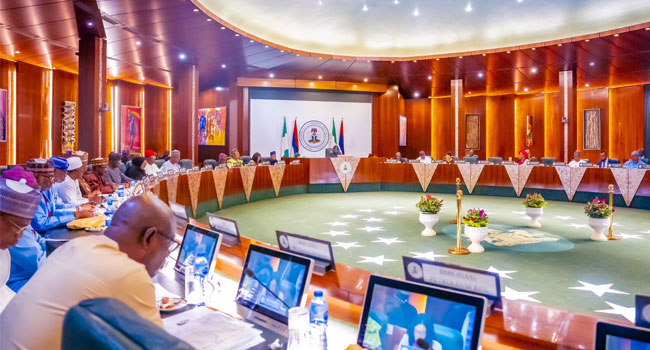
The National Economic Council (NEC), has warned the federal government, states and local governments against reversing ongoing economic reforms as political activities ahead of the 2027 general elections intensify.
The Council also reaffirmed its commitment to fiscal discipline, policy consistency and reform continuity, saying any reversal could undermine the economic gains recorded under the reforms.
The Minister of Finance and Coordinating Minister of the Economy, Taiwo Oyedele, disclosed this while briefing State House correspondents after the NEC meeting presided over by Vice President Kashim Shettima.
Oyedele said he briefed the council on the state of the economy, highlighting the progress made, opportunities ahead and challenges that remained, adding that the council deliberated extensively on the issues.
“I briefed Council on the state of the economy, highlighting the progress made, opportunities ahead, and challenges that remain. And council deliberated extensively on this topic. I’ll just share some highlights,” he said.
According to him, Nigeria’s economy has stabilised, but the task now is to translate economic stability into shared prosperity.
“Our real GDP growth rate was at 3.89 per cent for Q1 of 2026, which is up on 3.13 per cent one year ago, and it’s projected that our GDP growth rate for 2026 would be more than 4 per cent,” he said.
Oyedele said headline inflation fell to 15.43 per cent at the end of July, from 24.94 per cent a year earlier.
He, however, said food inflation remained elevated at 20.31 per cent at the end of July, although it was lower than the 26.2 per cent recorded a year earlier.
The minister said the country’s external reserves stood at $51.96billion, describing the figure as the highest since January 2009 and representing a 38 per cent year-on-year increase.
He added that the naira had appreciated by 13.5 per cent year-on-year by the end of the first half of 2026, with the exchange rate now below N1,400 to the dollar and “stable and steadily appreciating.”
On revenue, Oyedele said net Federation Account revenues rose by 44 per cent from N15.2trillion in 2024 to N21.9trillion in 2025, with an increase of at least 50 per cent projected for 2026.
He also said Nigeria’s trade surplus nearly doubled from N17.7trillion in 2025 to N34.7trillion by the first quarter of 2026.
The minister said total public debt remained moderate at below 37 per cent of GDP, amounting to N159.28trillion.
He added that debt service as a percentage of revenue had declined from nearly 100 per cent in 2022 to less than 60 per cent in 2025.
Oyedele said the economic gains had also been recognised by international markets and rating agencies.
“All three major rating agencies: Fitch, Moody’s, S&P upgraded Nigeria’s sovereign credit rating between April 2025 and May 2026, the first coordinated alignment in over a decade. So they all agreed,” he said.
He added that Nigeria exited the Financial Action Task Force Gray List in October 2025 and the European Union Anti-Money Laundering and Financing of Terrorism Deficiency List in January 2026.
According to him, the developments had lowered the cost and friction associated with cross-border capital flows into Nigeria.
Oyedele further disclosed that the sovereign spread between United States Treasury bonds and Nigeria’s Eurobonds had narrowed to a historic low of less than 200 basis points.
He said the Nigerian capital market was also one of the best performing in the world, with market capitalisation almost doubling in the past year.
The minister said the recent decision by FTSE Russell to reclassify Nigeria from unclassified to Frontier Market status was another positive development for the country.
“FTSE Russell just announced the reclassification of Nigeria from unclassified to the classification of a frontier market. This is good news for us as a country,” he said.
Oyedele explained that the reclassification could make Nigeria eligible for investment by international institutional investors who were previously unable to invest in the country because of certain ratings and classifications.
“The ratings, and none of them are important because they are investors around the world, especially institutional investors, that even if they want to invest in Nigeria, they can’t because we are not in certain ratings and classifications,” he said.
“So when FTSE Russell says Nigeria is classified under Frontier Market, that automatically makes us eligible for investment, for full credit investment, enabling international investors globally.”
He said the Nigerian capital market had already recorded significant gains before the FTSE Russell classification.
“And like I said, and in my briefing, the Nigerian capital market, I think 10th of July earlier this year, was the best performing in the world,” he said.
“We had a bit of correction in the past couple of weeks, which is normal, but even just in the past one year, even in dollar terms, the market has returned more than 60%. And this is even before the classification.”
Oyedele said the combination of improved macroeconomic fundamentals, new listings and Nigeria getting “on the right list” and “off the wrong list” pointed to better prospects ahead.
“So you can then imagine, with all the macros we analyze, and all these listings we are getting, getting on the right list, and getting off the wrong list, just means better days ahead,” he said.
He said the government expected more inflows of both foreign portfolio investment and foreign direct investment.
“So we expect more inflows of not just foreign portfolio investment, which is short-term, but we also expect the inflow of foreign direct investments in the coming days,” Oyedele said.
He described the period as exciting for Nigeria but stressed that the country must remain on the path of reform.
“So I think it’s an exciting time for us, and more reason why we have to stay the course of reform. And translate this as quickly as possible to micro outcomes for our people,” he said.
Oyedele said NEC identified agriculture, energy, manufacturing, mining and the digital economy as priority sectors for accelerating growth and lifting Nigerians out of poverty.
He said 81.4 per cent of Nigerians work in the agriculture sector and non-tradable services, making it necessary to accelerate growth in sectors where the majority of Nigerians work.
“That way, we lift them out of poverty and we close the inequality gap,” he said.
The minister said the council also recognised challenges that needed to be addressed collectively.
They included geopolitical conflicts, commodity shocks, persistent food inflation, management of the election cycle, fiscal risks and the economic narrative ahead of the elections.
He said there was a tendency for negative narratives to emerge before elections even when they were not supported by data.
Oyedele also said the government needed to ensure job-rate growth, manage foreign exchange vulnerability to portfolio-flow reversals, although the government did not expect such reversals, and develop a strategy to moderate lending rates to the real sector to stimulate growth.
According to Oyedele, NEC expressed concern about high interest rates, particularly the burden on businesses.
“Council expressed concern about the high rates of interest, particularly for businesses, and directed that we look at fiscal and monetary policy measures to moderate these interest rates,” he said.
Oyedele said NEC placed particular emphasis on staying the course of economic reforms to prevent a reversal of the gains recorded so far.
“There was a particular focus on staying the course of reform to avoid reversals,” he said.
He said the gains recorded in inflation, foreign reserves, the exchange rate and Nigeria’s credit ratings were the direct result of sustained and consistent policy.
“The gains on inflation reserves, the exchange rate, and our credit ratings are the direct result of sustained consistency consistent policy. They are reversible if we waver,” he said.
The minister said the government must therefore prevent reform fatigue and avoid populist reversals or election-cycle slippage that could undermine the credibility rebuilt over the past three years.
“So we need to prevent reform fatigue, avoid populist reversal or election cycle slippage that could forfeit the credibility we have spent the past three years rebuilding,” he said.
He said government at all levels had agreed that fiscal discipline must be maintained as political activities surrounding the 2027 elections intensify.
“Government at every level agreed; federal, state, and local governments, that we need to hold the line on fiscal discipline as 2027 political activities intensify,” Oyedele said.
The council also agreed to sustain policy consistency and ensure the domestication of complementary reforms at the subnational level, particularly in agriculture and land reform, while supporting vulnerable Nigerians.
Oyedele said states were expected to prioritise rural roads, storage, transport links and security investments in farming belts to improve agricultural productivity and food security.
Council also agreed to support a Job and Productivity Compact aimed at channelling private capital into agriculture, agro-processing, housing, logistics and light manufacturing.
The minister said states would also strengthen the tracking of inflation drivers, project delivery and welfare outcomes.
He said NEC had again reaffirmed its commitment to fiscal discipline and reform continuity as the 2027 election cycle approaches and intensifies.
Oyedele added that, as Finance Minister, he intended to share insights into the implications of some proposed policy reversals for the federation so that Nigerians would be properly informed.
He said the overall position of NEC was that Nigeria’s federal system operated on shared responsibility, with the federal government driving economic stability while states were responsible for delivering shared prosperity and local governments ensuring better living standards at the grassroots.
“Overall, Council deliberated and agreed that our federation is that of shared responsibility, where the center drives economic stability, but shared prosperity happens in the states, and better living standard must be delivered at the local level,” he said.